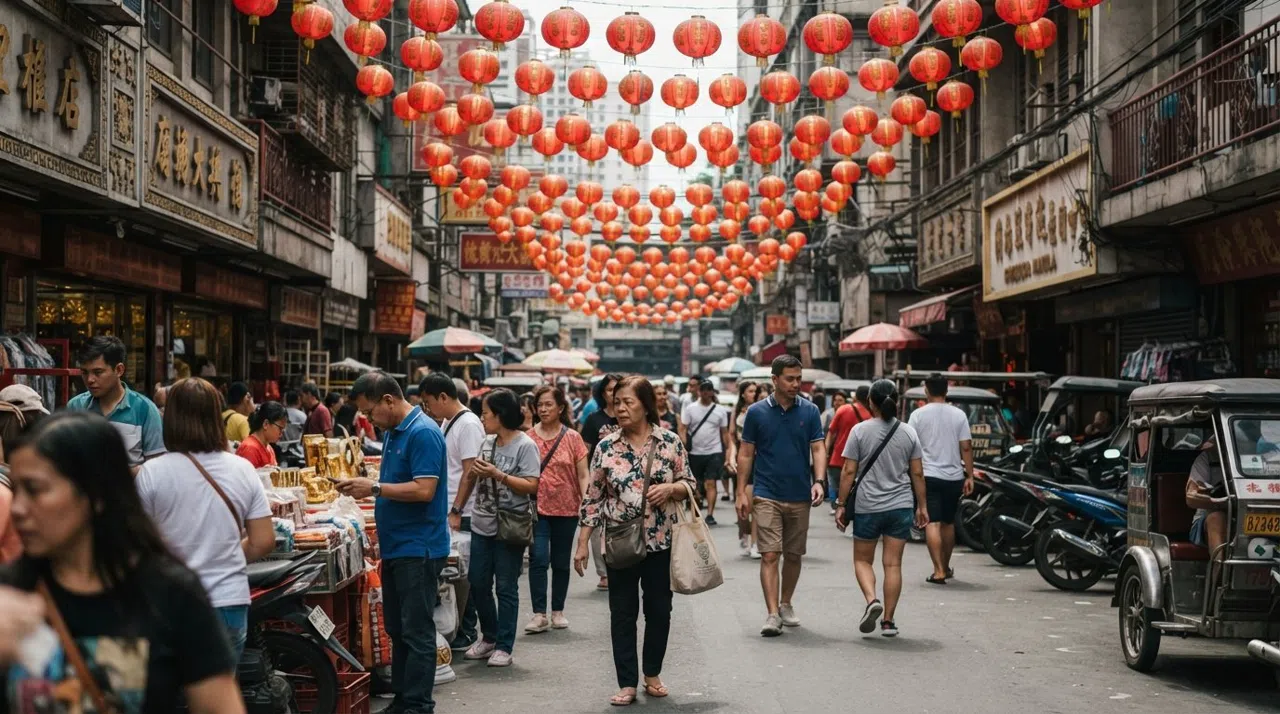
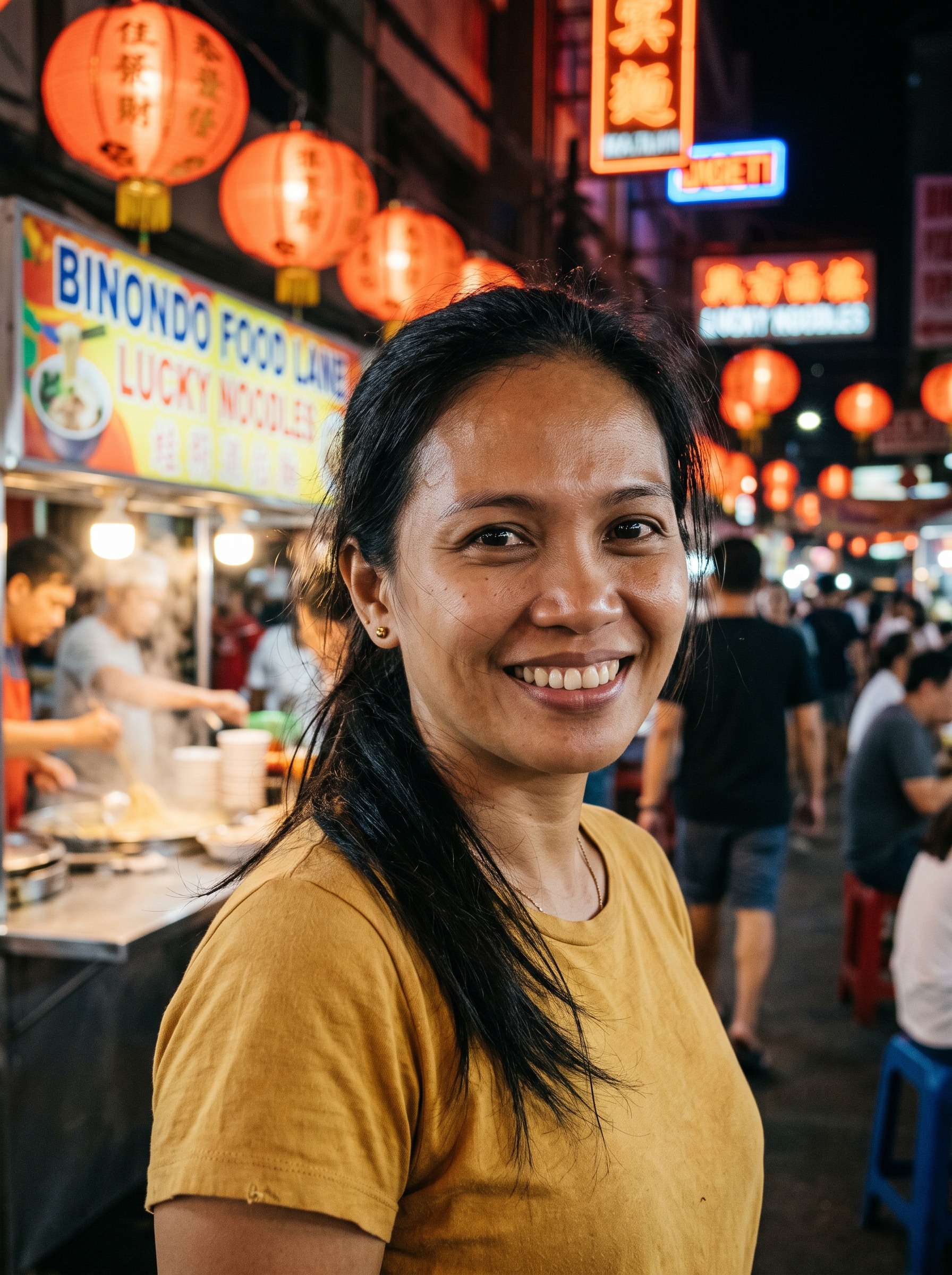
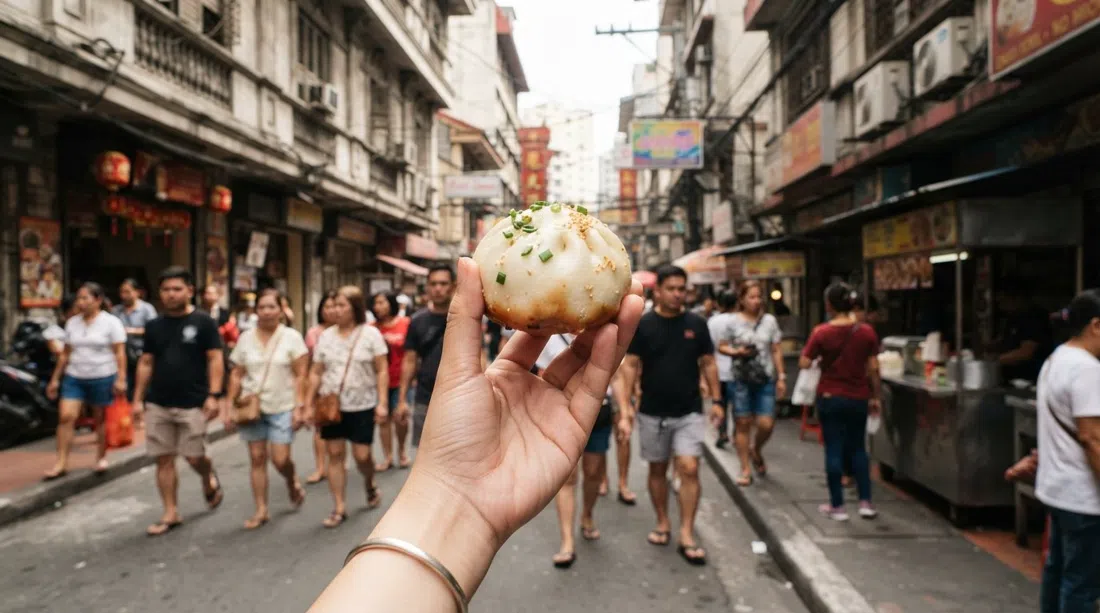
Binondo begins, as it should, with something hot and cheap in your hands: a plate of fried siopao from Shanghai Fried Siopao on Ongpin, crisp at the bottom and about ₱35 a bun, eaten while the street keeps moving around you.
That is the whole mood here. The Spanish set this pocket across the Pasig aside for Catholic Chinese merchants in 1594, and four centuries later Binondo still feels like a district built for transactions first and everything else second. You come for lunch, for pasalubong, for a temple detour, for a gold-ring errand you may or may not actually need. Almost nobody comes here to sleep. They come to eat, and the neighbourhood obliges with the kind of certainty that makes a long morning disappear before you notice you have crossed from breakfast into a full-scale crawl.
What Binondo is known for
Binondo’s claim is simple and unbeatable: it is the oldest Chinatown in the world, and it has been Manila’s mercantile engine ever since the colonial authorities planted it in 1594. That history is not trapped in a glass case. It sits in the street life, in the old Tsinoy families still running panciterias and bakeries opened by their great-grandparents, in the gold shops that make Ongpin Street gleam, in the temple bells that surface from side lanes, and in the fact that the district still runs on commerce and food in that order. There is no polish here and no pretence at it. The pavements are cracked, the lanes are narrow, and the soundtrack is a jumble of sizzling woks, clanging trolleys, Hokkien, Tagalog and the occasional bell from somewhere you cannot quite see.
The spiritual anchor is Binondo Church, officially the Minor Basilica and National Shrine of San Lorenzo Ruiz, fronting Plaza San Lorenzo Ruiz. It was founded by Dominican friars in 1596, and its octagonal granite bell tower survived British bombardment in 1762 as well as the flattening of Manila in World War II. San Lorenzo Ruiz, the first Filipino saint, was baptised here before his martyrdom in Japan, and the church’s elevation to a national shrine in September 2024 only sharpened its role as the district’s natural starting point.
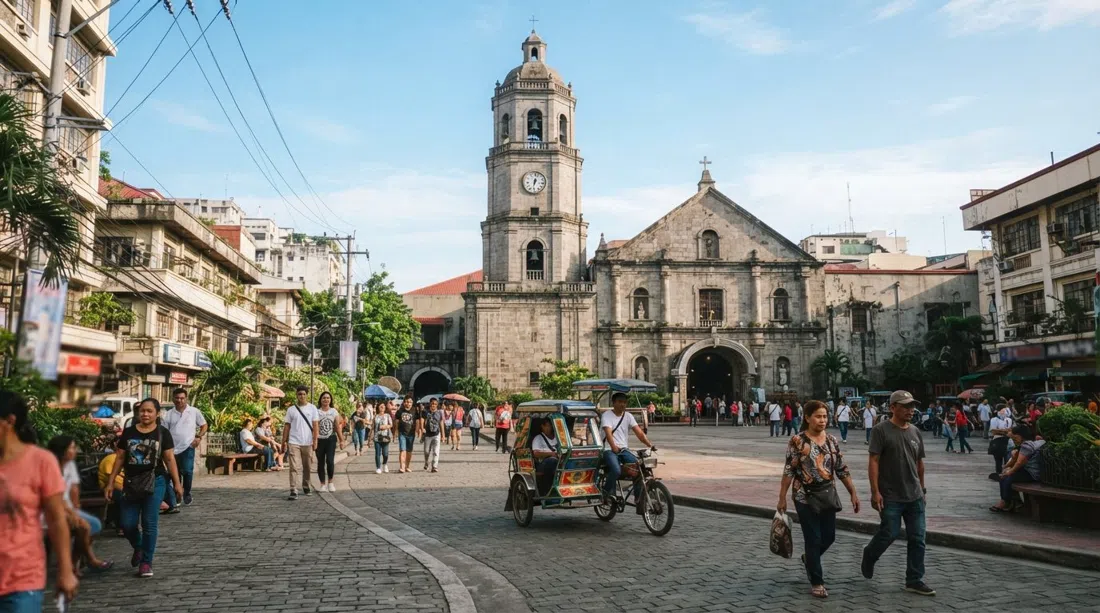
Stand in the plaza for a minute and the district starts to make sense. Red-and-gold arches vault over the main streets. Gold jewellers glitter under fluorescent light. Steam fogs the windows of eateries where plastic stools spill onto the sidewalk. Binondo is not a theme; it is a place people work in, shop in, pray in and, very often, eat in until they have to sit down somewhere and recover.
The district’s symbolic gateways, the Filipino-Chinese Friendship Arches, were built by the Tsinoy community to mark the 1975 diplomatic ties between the Philippines and China. They frame the streets with a kind of ceremonial optimism, but the real drama is still on the pavement below them: delivery trolleys squeezing past tricycles, hawkers calling out, and the steady flow of people heading toward Ongpin as if pulled by a magnet made of roast duck and noodles.
Where to eat & drink
If you do Binondo properly, you graze. Two or three things at a stop, then move on before the next queue grows longer. Bring cash. This is not the neighbourhood for card-reader confidence or leisurely indecision; the good places are busy because they are good, and some of them feel like they have been busy since your grandparents were young.
Start at Wai Ying Fastfood on Benavidez Street, the kind of no-frills Cantonese canteen that has no interest in charming you before lunch. It does not need to. The room is always packed, the turnover is brisk, and the plates come out with the kind of speed that suggests the kitchen has been doing this forever: steamed hakaw, siomai, congee, roast-duck noodles, milk tea. It is a place to arrive hungry and slightly unglamorous, which is exactly right.
A few doors away, Lan Zhou La Mien gives you a different kind of theatre. The shop is tiny, barely seating a dozen, and the draw is watching the beef noodles being pulled by hand before they are dropped into a deep broth. The strands are thick and chewy, the broth rich enough to feel like a meal and a half, and the whole thing has the satisfying directness of food that was never designed to impress anybody except people who like eating.
Then there is Sincerity Cafe & Restaurant, the Uy-family institution that has been around since 1956 and remains the name people hand over when you ask where to go for fried chicken. Order it with oyster cake and fresh lumpia, and you get the Binondo version of a complete sentence: crunchy, savoury, a little messy, and gone too quickly. Sincerity has branches on Quintin Paredes and inside Lucky Chinatown Mall, but the point is not the branch count. The point is that the place has stayed itself long enough to become part of the neighbourhood’s memory.
Dong Bei Dumplings on Yuchengco Street is the sort of stop that rewards self-control only if you have none. Its kutchay dumplings and xiao long bao are made fresh daily and sold by the dozen, largely for takeaway. The counter is not trying to seduce you with atmosphere; it is trying to get dumplings into your bag before you change your mind.
If you want a snack with a little drama, Shanghai Fried Siopao on Ongpin is the one. The pork-and-chive buns are fried until the bottoms go crisp and golden, and at around ₱35 each they are exactly the kind of bargain that makes you reconsider your lunch plan. You can eat one on the street and still have room for the next thing, which is part of the Binondo game.
Masuki on Benavidez has been ladling its signature chicken mami noodle soup for generations. It is one of those places that feels less like a restaurant than a family object still in use. The bowl is comforting without being sentimental, the sort of thing you want when the heat has worked on you and you need something warm and familiar to reset the day.
For dessert and take-home duty, Eng Bee Tin on Quintin Paredes is the obvious stop. This is the deli that invented the ube hopia in the 1980s, and it remains the district’s most famous place for hopia, tikoy and mooncakes. The boxes are part souvenir, part strategy: you buy them for later and then end up opening one before you’ve even left the street.
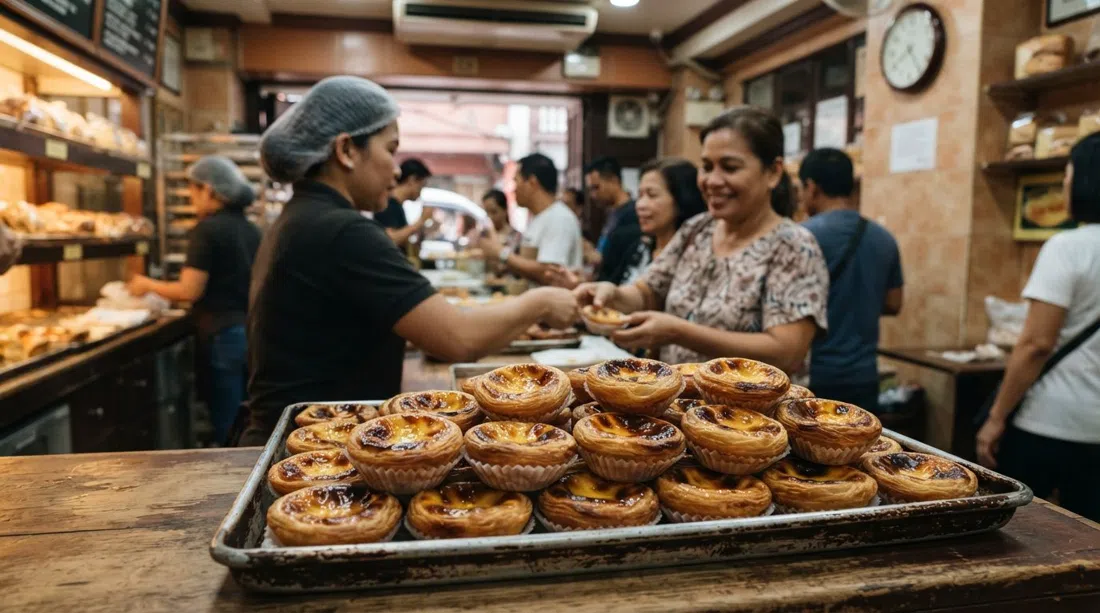
And if you want something sweet and slightly more delicate, Lord Stow’s Bakery on Ongpin does Macau-style Portuguese egg tarts with a flaky, blistered top. Eat them while they are still warm if you can. Otherwise they are still good, but warm is better, and Binondo is not a place that rewards overthinking pastry.
Things to do
Binondo is best approached on foot, ideally with someone who knows which doors open to more than they seem to. The gold-standard walk is Big Binondo Food Wok by Ivan Man Dy of Old Manila Walks, a roughly 3.5-hour heritage-and-food tour that starts at 9am from the lobby of Binondo Church and costs around ₱1,400 including all the eating. That detail matters because it tells you what Binondo really is: not a museum district with snacks, but a living neighbourhood where history is threaded through lunch. Ivan guided Anthony Bourdain through here for No Reservations, which is a neat credential, but the real reason to take the walk is simpler — somebody who knows the lanes can turn a crowded morning into a sequence of discoveries instead of a series of missed turns.
Start at Binondo Church and Plaza San Lorenzo Ruiz, then work your way up Ongpin Street, where the gold shops make the whole avenue shimmer. Duck under the Filipino-Chinese Friendship Arches and keep going. The street is the spine of Chinatown, but it is also a kind of open-air archive: jewellers, old eateries, hawkers, the occasional temple entrance tucked above a staircase, and always the feeling that something is being bought, sold, cooked or carried.
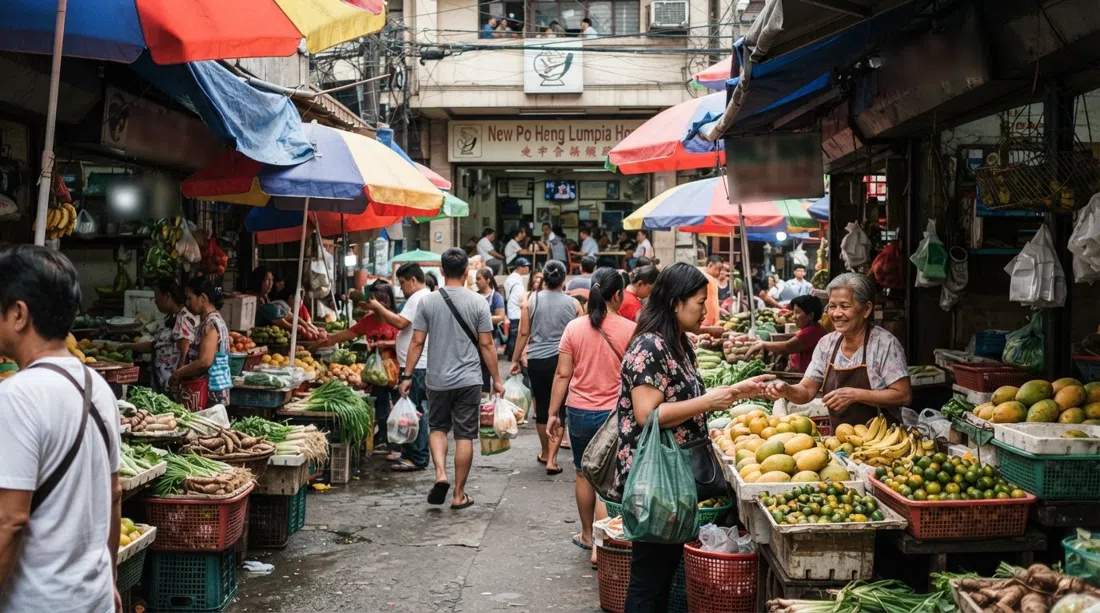
The lane everyone remembers is Carvajal Street, better known as Umbrella Alley, or HoSuwaHang in Hokkien. It is narrow, shaded by awnings, and packed with fruit, vegetable and seafood vendors in a way that feels almost cinematic until you remember that this is just how the street works every day. Carvajal is also where you find New Po Heng Lumpia House, rolling fresh lumpia to order, and Quik Snack, a place that has been going since 1967 and serves old-school Hokkien plates like kuchay ah pie and sate beef noodles. This is Binondo at its most intimate: close quarters, quick hands, no room for fuss.
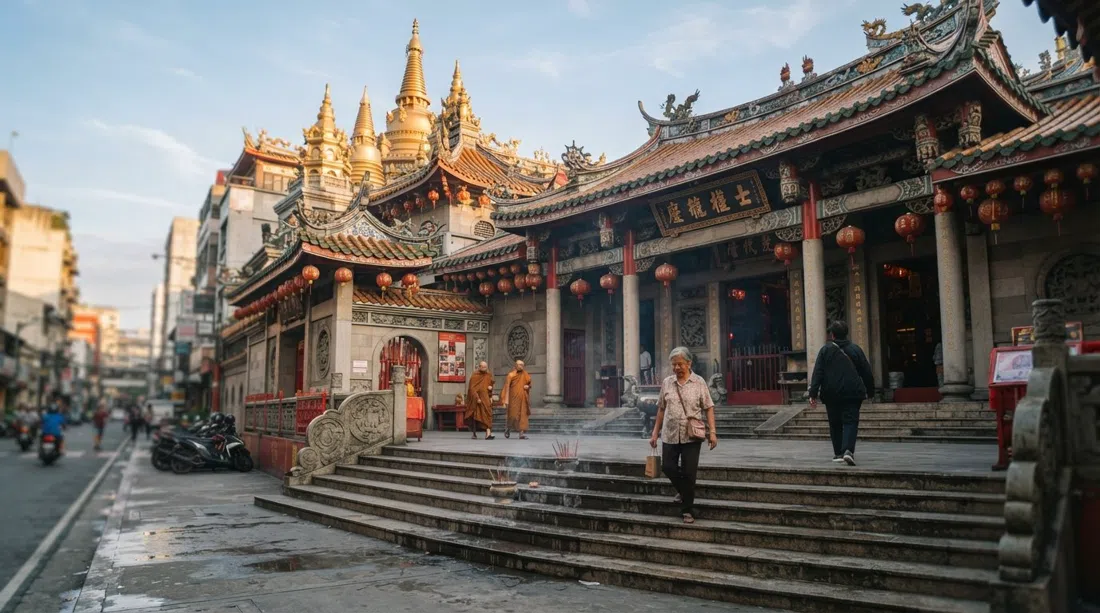
For a quieter moment, climb to Seng Guan Temple on Narra Street at the district’s Tondo edge. It is a three-storey Mahayana temple crowned with golden stupas and known as the Temple of a Thousand Buddhas. Early morning is the calmest time to visit, when the air is still soft and the district has not yet fully switched on. From there, the contrast is part of the pleasure: below you, the market district; above, a space of incense, gold and stillness.
If you want a bigger day, cross the handsome 1910s Jones Bridge and you are minutes from Intramuros. That is one of Binondo’s best tricks: it lets you pair old Chinatown with colonial Manila without making a production of it. One minute you are in a lane of noodle shops and jewellery counters; the next you are looking at a bridge that carries you toward another version of the city entirely.
Shopping & markets
Ongpin Street is the country’s gold and jewellery capital, and even if you have no intention of buying anything, the display cases are worth a slow walk. Chains, bangles, rings — all of it sold by weight, all of it lit to catch the eye. Window-shopping here is not a consolation prize. It is part of the experience, because Ongpin’s shine tells you exactly what kind of district this has always been: one where value is visible and commerce is never far from the surface.
The edible shopping is even better. A Binondo visit is not complete without a pasalubong run, and Eng Bee Tin on Quintin Paredes is the obvious anchor for tikoy, mooncakes and boxes of ube hopia. There are old bakeries along Ongpin that still handle kuchay pastries, and Lord Stow’s gives you egg tarts to carry home if you can resist eating them on the way.
For raw ingredients and a bit of spectacle, Carvajal Street is the photogenic market lane, all stretched awnings and close-packed vendors selling fruit, vegetables, seafood and dried goods. It is the sort of place where every hand seems occupied and every inch of space is doing a job. North of there, Divisoria and Arranque go much harder: fabric, cheap electronics, rock-bottom prices, and the sort of chaotic crush that demands a firm grip on your bag and a little patience with the crowd. That is not a warning so much as a heads-up. Binondo is a working district, and the markets behave accordingly.
Where to stay in Binondo
Most people do not stay in Binondo, and that is fine. Makati and BGC are the usual bases, 20 to 40 minutes away by car depending on traffic, and they make more sense if you want nightlife, cleaner pavements and a quieter night’s sleep. Binondo is for waking up early, eating hard and leaving with a bag of pastries and a little grease on your shirt.
If you do want to stay here, the practical anchor is the Lucky Chinatown complex, a modern mall-and-hotel development on the district’s edge that gives you air-conditioning, familiar chains and a supermarket within walking distance of the chaos. Around Ongpin, Reina Regente and Quintin Paredes you will also find no-frills business hotels aimed at traders. They are cheap and central, though not the sort of places you brag about on Instagram. Streets closest to the market lanes are the liveliest and loudest, so if you want any quiet, choose a room a block or two off Ongpin. Budget is the operative word here, and that is part of the charm: Binondo is one of the most affordable areas in Manila to stay if your priorities are food and heritage rather than polish.
Getting around
Binondo is small enough to walk, and walking is the point. The lanes are too narrow and too clogged for anything else to feel natural, and the whole core can be covered in an afternoon if you are not in a hurry. Wear closed shoes; the pavements can be uneven and sometimes wet, and the neighbourhood has no interest in making itself easy for sandals.
If you are coming by train, take LRT Line 1 to Carriedo station and walk 10 to 15 minutes past Santa Cruz Church into Chinatown. LRT Line 2 to Recto is a similar walk from the other side. Jeepneys heading to Divisoria pass right through, and you can flag one and ask to be dropped at Binondo. The simplest option for most visitors is Grab or a taxi: set your destination to Binondo Church or Ongpin Street and let the driver sort out the last stretch.
From Makati or BGC, budget 20 to 40 minutes by car. From Ninoy Aquino International Airport, it is roughly 40 to 60 minutes depending on traffic, which in Manila can be considerable. Intramuros and old Manila are just across Jones Bridge, so the two pair naturally in one day. That is a very Manila kind of convenience: messy, slightly exhausting, but genuinely useful.
Why Binondo still matters
Binondo is not quaint, and that is precisely why it works. It has survived as a place of trade, prayer and eating because it never stopped being useful to the city around it. The old families kept the recipes going, the gold shops kept shining, the temple bells kept ringing, and the streets kept feeding people who know that the best lunch in Manila may still come from a plastic stool beside a steam-fogged window. If you want a neighbourhood that behaves like a living argument for the city’s appetite, this is it. Come late morning, come hungry, and give yourself permission to keep walking after the first bowl.