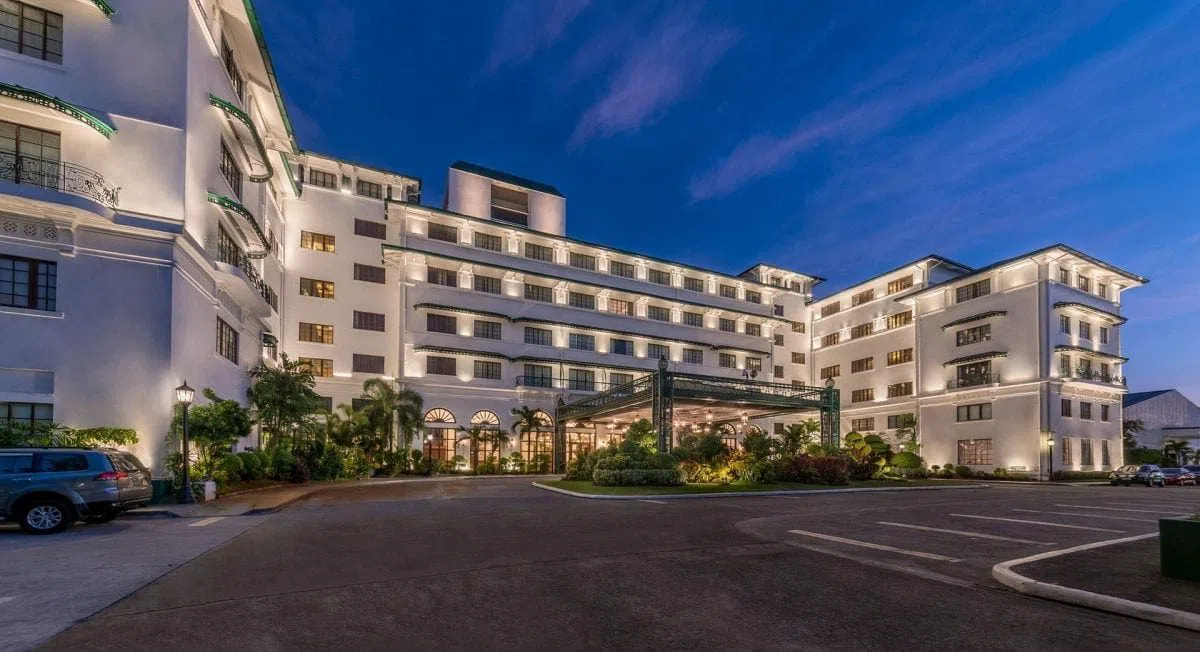

The lobby of the Manila Hotel smells of cut flowers and floor polish, and it has smelled of them through an American colony, a Japanese occupation, a republic, a dictatorship and four decades of elections since. Non-guests are welcome to sit in it, which makes the grandest room in the city also one of its cheapest archives, for roughly the price of a coffee. What follows is a route that begins at that door, walks the bay and the walled city around it, and ends fifty years and a few kilometres away.
The lobby that opened on the Fourth of July
The Manila Hotel (Ermita, at the northern end of Rizal Park) opened on 4 July 1912, and the date was chosen rather than stumbled into: an American colonial government putting its own national holiday on the cornerstone of the city's first grand hotel. In 2026 the hotel is in its 114th year and is marking it with the "I Remember the Day" campaign, which runs to 31 December and collects guests' own hotel memories: the weddings, the proposals, the lobby used as a neutral meeting point in decades when neutral meeting points were scarce.
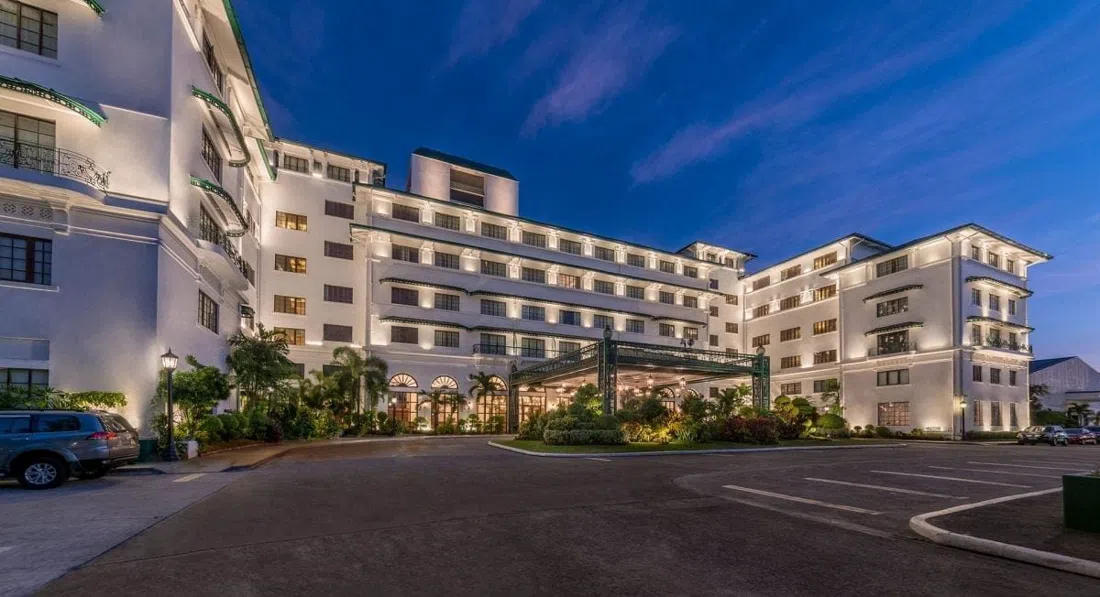
The practical thing to know is that the lobby is open to people who are not staying. You can order coffee or sit down to afternoon tea without a room key and without a reservation, and nobody will hurry you while your order lasts. Dress tidily (this is a jacket-and-leather-shoes room in spirit, if no longer in rule) and give yourself an hour rather than twenty minutes. The scale is the point: a long run of marble, dark hardwood, chandeliers at a height that no modern hotel pays for, and a procession of people crossing it who are plainly here for something consequential.
Douglas MacArthur lived in this building from 1935, when he came to advise the Commonwealth on building an army, and the hotel has never stopped trading on it. A small MacArthur museum sits off the lobby; it is not well signposted and not always staffed, so ask at the front desk rather than hunting for it. If you want to sleep inside the legend, the MacArthur Suite goes for PHP 79,000 nett for up to six people, which is a real number for a family or two couples splitting it and absurd for one. Ordinary rooms run roughly PHP 9,000-18,000 (USD 155-310). Pay for a bay view, and expect a heritage hotel rather than a new one: the lifts, the bathrooms and the corridors are of their era.
Be clear-eyed about what the lobby tells you. It presents the twentieth century as a sequence of arrivals and galas. The hotel did not pass through the Battle of Manila in 1945 untouched, and the rooms you walk through are the product of repeated restoration rather than unbroken survival. The counterweight is a fifteen-minute walk away, and this route goes there.
For groups, this is the most capable address in the old district. The Fiesta Pavilion takes 1,100 and divides into three halls (Pandanggo, Polkabal and Rigodon), while Centennial Hall seats 550. Wedding and conference enquiries are handled by a dedicated team, and the halls book out a year ahead for December and for the summer wedding months, so a speculative email three weeks out is wasted effort.
One piece of geography is worth knowing before you walk on. On 4 July 1946 the Philippine republic was inaugurated a few hundred metres down the same park. The hotel's birthday and the old date of national independence are the same day, in sight of each other.
Three minutes along the bay to the plain survivor
Bayview Park Hotel Manila (Ermita, at the Roxas Boulevard end of United Nations Avenue) is three minutes' walk from the Manila Hotel's gates and a different century of hospitality altogether. It has operated as a hotel on this bayfront since the mid-1930s under Dr Harry Kneedler, when the road outside was still Dewey Boulevard, named for the admiral whose squadron sank the Spanish fleet in the bay in 1898. The street name changed; the address kept trading.
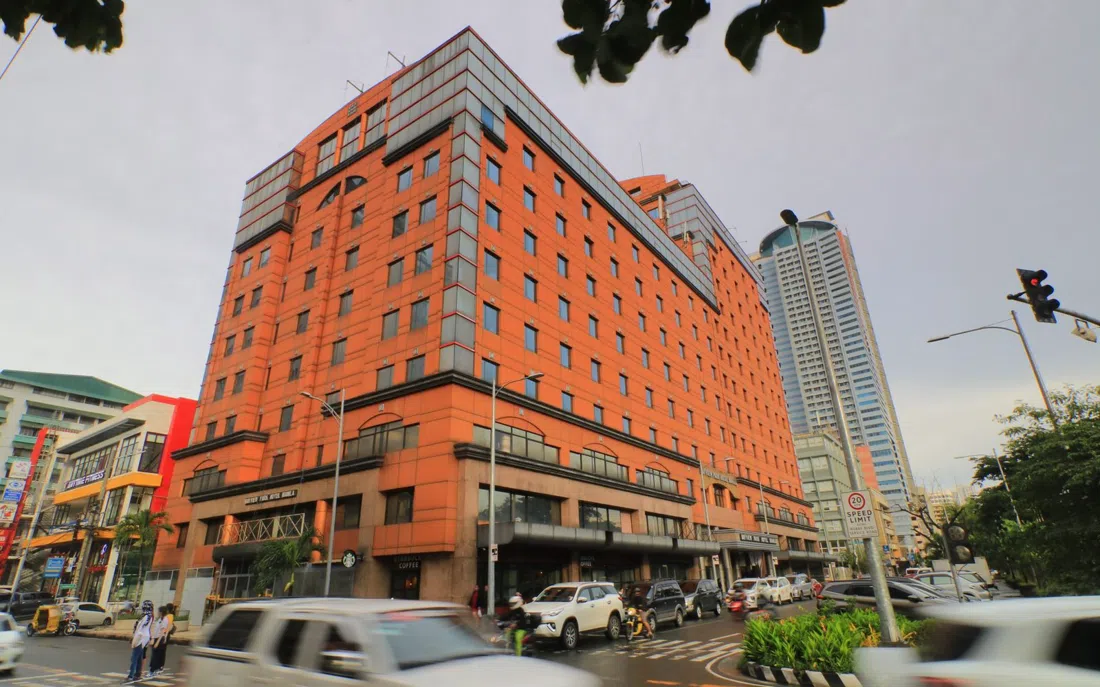
Do not come expecting a heritage interior. What you get is 283 rooms at roughly PHP 2,700-5,000 (USD 46-86), fourteen function rooms taking up to 400 guests, and the unglamorous competence of a hotel that has fed and housed delegations, pageant contestants and church conventions for generations. It is the single best-value base on this route if you are travelling in a group of more than six, or if you would rather spend your money on the city than on the lobby. Couples after romance should look elsewhere; families and tour groups who want to walk to Intramuros, the park and the museums will find nothing better at the price. Browse the wider Manila hotel search if you want to compare the bayfront strip room by room.
Stand on the corner for a moment before you move on. In one line of sight you have the grand hotel, the workaday hotel and the seawall: two ends of the same industry, built on the same water, three minutes apart.
A 1939 facade rebuilt from the ground up
South along the boulevard, Admiral Hotel Manila – MGallery Collection (Malate, on Roxas Boulevard) raises the hardest question on this walk. The original went up in 1939 as the Admiral Apartments, was requisitioned by American command and then by Japanese command during the war, and spent the following decades sliding into disrepair. In 2012 it was controversially demolished. What stands today is a 2022 hotel behind a replica of the pre-war facade, and the building has been in the MICHELIN Guide for 2024 and 2025.

That sequence is worth sitting with rather than glossing. This is a genuinely good hotel, with rooms at roughly PHP 8,000-16,000 (USD 140-275), a cool and quiet interior, excellent service and bay views from the upper floors. It is also not an old building. If you came to touch 1939, you will be touching a 2022 wall with 1939's proportions. If you came to sleep well two kilometres from Intramuros with the sunset out of the window, it is one of the best choices in the city.
For events it sits in a useful gap. The Grand Harbour Ballroom holds 110 guests across 192 square metres, with suite-ballroom breakout spaces alongside, and the rooftop Admiral Club and the Coconut Grove bar both take private parties. That makes it the right address for a small buyout, a milestone birthday or a corporate offsite of under a hundred, the kind of booking that would rattle around inside the Fiesta Pavilion. Expect a dress code on the rooftop in the evening, and expect walk-in couples to be seated before walk-in groups of eight.
The version of these decades with no chandeliers
Walk or take a short ride north into the walled city for Fort Santiago and the Rizal Shrine (Intramuros). Entry is PHP 75 for adults and PHP 50 for students, seniors and persons with disability. It opens at 8am on weekdays and from 6am at weekends, closes at 10pm, and the last entry is 8pm, so an early weekend start is the one reliable way to see it before the heat arrives.

Inside are the cell where José Rizal spent his final hours in December 1896 and the brass footsteps set into the ground tracing his walk to the execution field. Further in, below the level of the Pasig, are the river-level cells where prisoners died when the tide came up. This is the same span of decades the hotel lobby narrates in portraits and plaques, told from the receiving end, and it is the reason to do these two places on the same day rather than on separate ones.
Guided group tours run 1 to 1.5 hours and coaches drop at the Intramuros gates, so this works well for a party of thirty. For couples and solo travellers the fort rewards going slowly and unguided; read the panels, then walk the ramparts for the river view. Bring water and small notes, because the ticket window is not the place to present a card and hope.
The hall where the republic was actually legislated
Five minutes back toward the hotel, the National Museum of Fine Arts (Ermita, on Padre Burgos Avenue, facing Rizal Park) occupies the Old Congress Building. The legislature sat here from 1926 to 1972, and the Senate returned to it from 1987 to 1997. The laws that built, suspended and rebuilt the country described in the hotel's lobby photographs were argued in these rooms, including the old session hall that now hangs Juan Luna's enormous Spoliarium as its centrepiece.
Entry is free. Opening is roughly 9am to 6pm, but check the official page before you commit a group to a slot, because individual galleries and whole wings close for holidays, installations and maintenance without much notice. The building absorbs school parties and tour groups easily; guided groups should book ahead. Two unhurried hours is right, and one hour is enough if you came for the session hall and the Luna.
Above the walls at the first seating
End the daylight at The Bayleaf Intramuros (Intramuros, inside the walls near the cathedral), whose Sky Deck is the one place in the old city where the whole geography of this story resolves at once: the fort, the river mouth, the bay, the length of Rizal Park and the roofline of the Manila Hotel at the end of it.
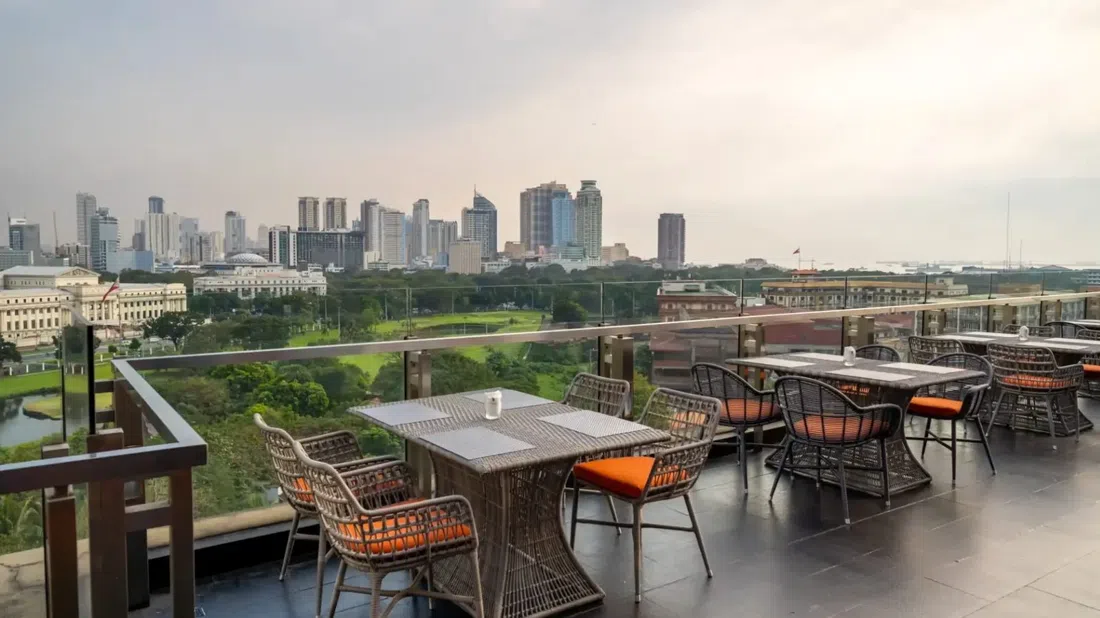
The Sky Deck runs two fixed seatings, 4-7pm and 7-11pm, and takes group reservations. Book the first seating and arrive at the start of it, because sunset is the busiest hour of the day up there and walk-ins get turned away at peak, politely and firmly. Mains run roughly PHP 500-900, so this is a proper dinner rather than a drinks stop, and the kitchen is better than a view restaurant needs to be. Rooms in the hotel below cost about PHP 4,500-8,000 (USD 78-138) and are the best way to wake up inside the walls; there are meeting rooms too, which is rare in Intramuros.
Couples should ask for a railing table when reserving. Groups of more than eight will be seated inland from the edge. That is the trade, and it is worth knowing before anyone is disappointed.
The fiftieth birthday that bookends the first
If you have a second day, cross the metro to The Peninsula Manila (Makati, at the Ayala Avenue corner), which turns 50 in 2026. Since 24 June its 50th Anniversary Timeline Exhibition has run in The Lobby, tracing the hotel from its 1975 groundbreaking to the present. Read it immediately after the Manila Hotel and the pairing does real work: one hotel narrates the colony, the war and the young republic, the other narrates the boom, the crises and the money that followed.
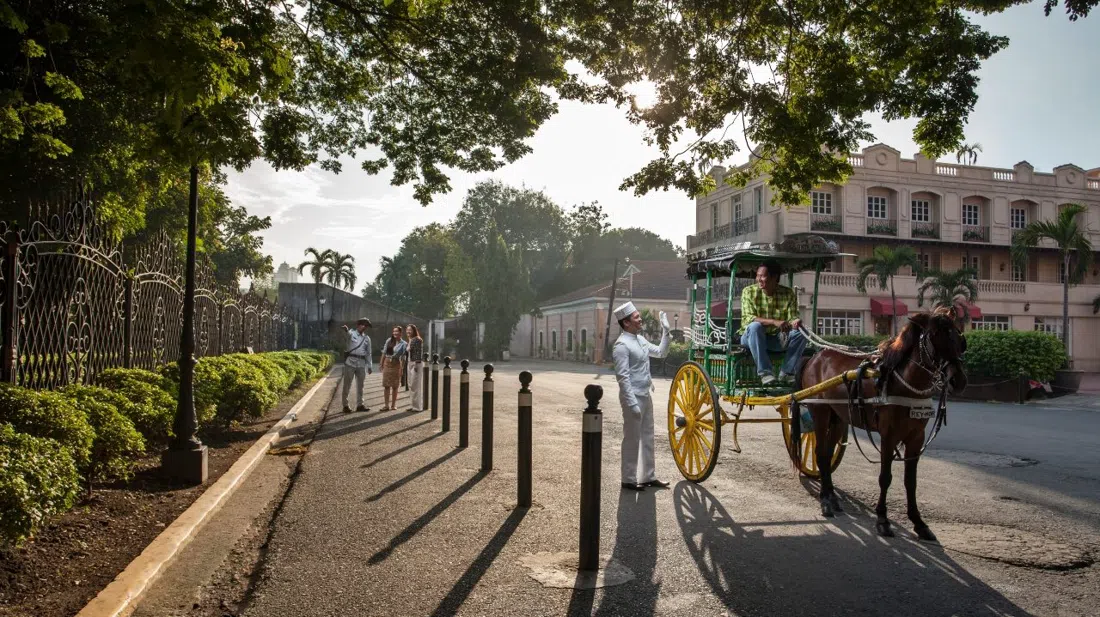
The Lobby here is a famous open meeting point in its own right and needs no reservation for coffee, though afternoon tea does fill at weekends. Rooms run roughly PHP 12,000-25,000 (USD 205-430), and a phased renovation is underway, so ask which tower your room sits in when you book, and ask directly, because the difference is audible. The Rigodon Ballroom seats 450 for a banquet or 680 for a reception, with the Rigodon Garden alongside, which makes it the city's default for large formal events. Note the name: both of this route's great hotels named their principal room after the rigodon de honor, the ballroom dance of the old colonial elite. The city has been quoting itself for a century.
Practical notes
The whole first day is walkable. LRT-1 Central Terminal station puts you at the edge of Intramuros, United Nations Avenue station lands between the Manila Hotel and Bayview Park, and Pedro Gil is the nearest stop to the Admiral, about a ten-minute walk. Ride-hailing is the easy default for the Admiral and essential for Makati, so budget 30 to 75 minutes to the Peninsula depending on the hour, and avoid 5-8pm in either direction.
The currency is the Philippine peso. Carry small notes for Fort Santiago entry, tricycle and jeepney hops and bottled water; the hotels, the Sky Deck and the museums' shops all take cards. The National Museum of Fine Arts charges nothing at all.
Start at 8am, or 6am on a weekend, and do Fort Santiago first while the walls still throw shade. Keep the museum for the hottest part of the afternoon, since it is air-conditioned and free, and hold the hotel lobby for either breakfast or late afternoon tea. December to February is the driest and coolest window; June to October brings afternoon rain that can shut a rooftop with no notice, so have the museum as your wet-weather swap.
A full day on this route costs very little: PHP 75 at the fort, nothing at the museum, PHP 400-700 for coffee or tea in the Manila Hotel lobby, and PHP 1,200-2,000 a head for dinner on the Sky Deck with a drink. Sleeping on it is where the range opens: PHP 2,700 at Bayview Park against PHP 79,000 for the MacArthur Suite, on the same stretch of bay. For what else to build around these days, see the wider Manila guide.