Het Manila-nummer
De Bataan Death March-route in één dag rijden vanuit Manila
Een volle dag rijden vanuit Manila langs de weg die 70.000 overgegeven mannen in 1942 moesten lopen, met wat het kost en wat er nu gesloten is, helder uiteengezet.

Door Enzo SyBinondo mornings, carinderia to kamayan
The drive out of Manila starts before dawn, while the expressway is still only trucks and bus headlights, and you reach the far side of the bay just as the heat arrives. There is no ticket office where this trip begins, only a low stone marker on an open plaza with a zero cut into it, a few minutes from the water. In April 1942, tens of thousands of surrendered men were formed into columns on that ground and told to start walking north. Everything else you see that day sits downstream of that plaza, and the road you drive is the road they walked.
What you are actually tracing
Bataan is the mountainous peninsula on the western side of Manila Bay, close enough to see from the capital on a clear morning and still a three-hour drive away. When the American and Filipino force holding it capitulated on 9 April 1942, somewhere in the region of 70,000 prisoners, the large majority of them Filipino, were moved north on foot through the hottest, driest weeks of the year, with almost no water, almost no food and no transport for the sick. The walking distance was roughly 105 kilometres from the peninsula's southern tip up to the railhead in Pampanga, after which men were packed into closed boxcars for the last leg to a prison camp in Tarlac. Prisoners who fell out of the column were bayoneted, shot or left. The number who died on the march itself has never been settled and historians still argue the range; what is not in dispute is that it ran to thousands.
What survives is not a battlefield. It is a line of markers along a working national road: kilometre posts, bronze plaques, a hilltop shrine, a roadside slab almost nobody slows down for. No single visitor centre stitches it together and there is no signed trail. That absence sets the character of the day. You are reading a road rather than touring an exhibit, and it rewards planning more than almost any other trip out of the capital.
Plan je reis naar Manila
Actuele prijzen van onze boekingspartners.
Gratis annuleren bij veel kamers. We kunnen een commissie ontvangen als je boekt.
Kilometre zero at Mariveles
Start where it started. The Zero Kilometre Death March Marker (Mariveles, at the southern tip of the peninsula) is an open public plaza with no gate, no ticket and no closing time, and the National Historical Commission of the Philippines formally recognised it in March 2017 as the march's starting point. It is free. Coaches can park on the municipal hall approach, and any size of group can stand there and lay a wreath without arranging anything in advance. Give it longer than it looks like it needs. Fifteen quiet minutes with the sea behind you and the mountain road climbing away in front will do more for you than anything else that day, because from here the distances stop being abstract.
A two-minute walk away is the Philippine–Japanese Friendship Tower (Mariveles), raised in 1975 by the Japanese Buddhist lay organisation Risshō Kōsei Kai together with Bataan's provincial government. It is an open memorial park, free, with no ticketing, and it handles groups easily. Japanese pilgrimage parties come to lay flowers here, so wreath-laying is ordinary rather than exceptional. For an international reader this is the half of the story most itineraries skip. You can stand where the column formed and, a hundred paces later, at a monument two nations built together thirty-three years afterwards. Put them in that order, not the reverse.
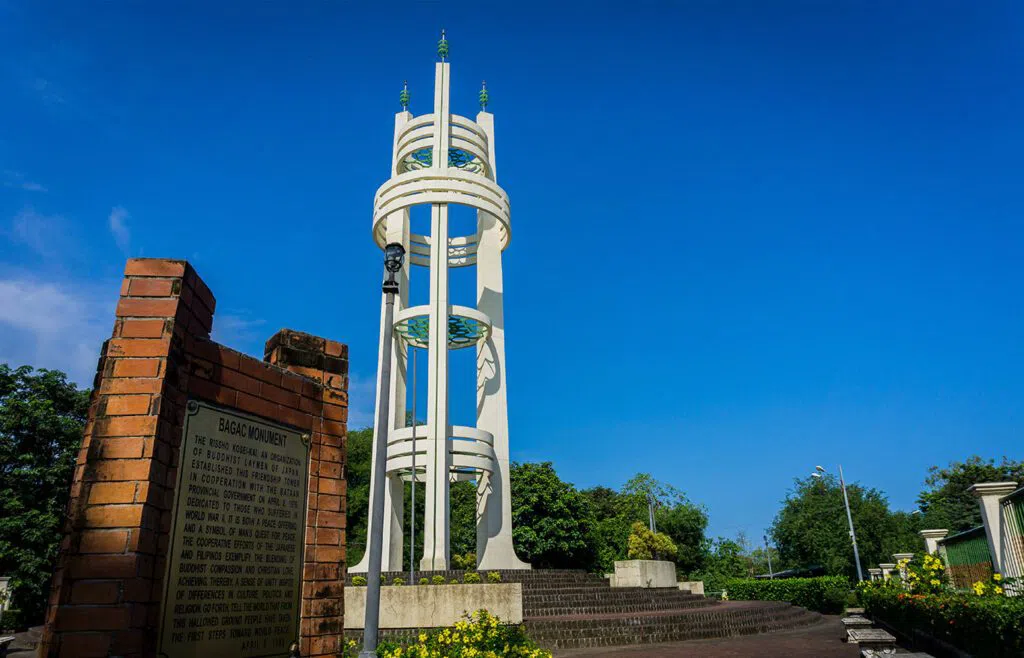
The march had two starting points, not one, and it is worth knowing that before you set off. A second column began on the peninsula's west coast at Bagac. Most day trips use Mariveles because it is the recognised kilometre zero and because the road from there runs the right way, but if someone tells you there is only one zero marker in Bataan, they are simplifying.
The marker almost nobody stops at
Drive north up the east coast and, in the barangay of Lamao, you pass the Surrender Site Marker (Lamao, Limay) with no fanfare at all. This is where Maj. Gen. Edward P. King surrendered to Col. Motoo Nakayama on 9 April 1942, the largest capitulation in United States military history and the specific event that created the march you are following. The marker was placed here through the efforts of the Battling Bastards of Bataan and the researcher Edna Binkowski, and it is roadside public ground: no gate, no fee, nobody collecting anything.
It is also easy to drive straight past, and almost no organised tour pulls in. A car party of four stands comfortably on the verge; a full coach cannot, and will have to park on the national road itself, which on a weekday with cement trucks coming through is genuinely unpleasant. If you are in a large group, decide in advance whether you are stopping properly or not stopping at all, because a hurried thirty seconds with one wheel on the carriageway serves nobody. For a small car party this is the stop that turns the day from sightseeing into something closer to understanding, because the sequence suddenly reads correctly: the surrender here, the walk from there.
Mount Samat and what is shut
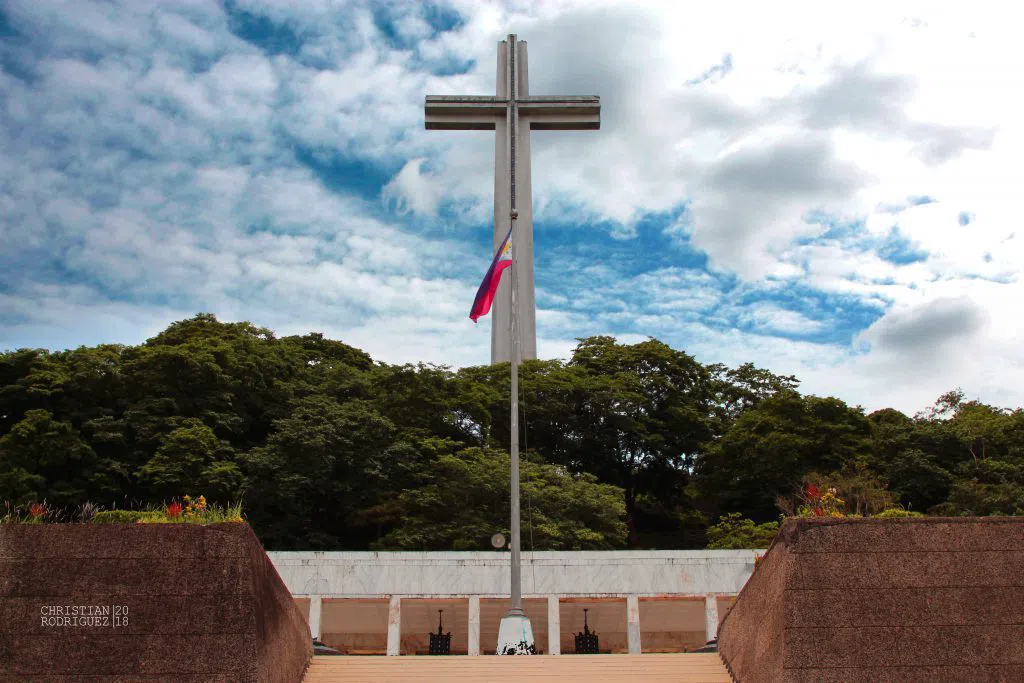
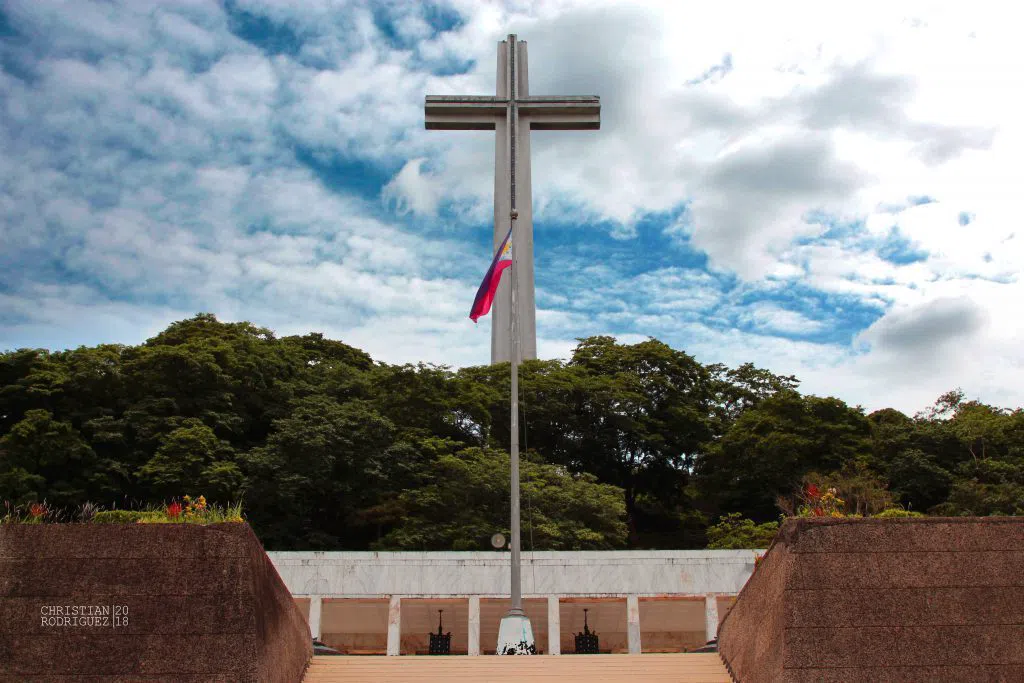
Inland and uphill, Mount Samat National Shrine (Dambana ng Kagitingan) (Pilar, inland Bataan) is the anchor of the whole route and the one place that looks like a monument in the way visitors expect. The entrance is around PHP 50 per person, parking is free, and some visitors report walking the grounds without paying anything at all. No booking is needed. It takes coaches, school parties and veteran groups freely, since the hilltop car park and esplanade are built for them, and discounted group rates are quoted on site rather than online.
Before you drive 90 minutes up a mountain: the lift inside the great cross, the viewing gallery in its arms and the shrine museum are all shut for structural retrofitting. The Philippine Veterans Affairs Office procured the works, which have been running since 2025, and a new visitors' complex costing PHP 170 million is due around June 2027. So you get the Colonnade, the marble altar and the ridge views, and they are worth the climb, with the peninsula falling away toward the bay on one side and the plains on the other. You do not get the gallery at the cross's arms and you do not get the exhibits. If a driver or guide promises you the view from inside the cross, correct them.
Allow an hour to ninety minutes here. The road up is steep, narrow in places and hard work for a big coach, and mid-morning, before the haze thickens, gives the best of the view.
Coffee, lunch and one deliberate gear-change
The memorials have almost no facilities, no cafés and barely a toilet worth the name, so plan your breaks around that rather than hoping. Plaza Brew Coffee Company (opposite the plaza in Bataan's provincial capital) is the one properly cool, clean, sit-down coffee stop on the Bataan stretch, a short walk from the town museum, and it runs about PHP 150 to 350 for coffee and a pastry. It is a small room: fine for a car party of four to eight, tight for more. If you are a dozen or more, ring the hotel on +63 47 237 1037 and ask them to hold seating, because turning up unannounced with fourteen people will not work.

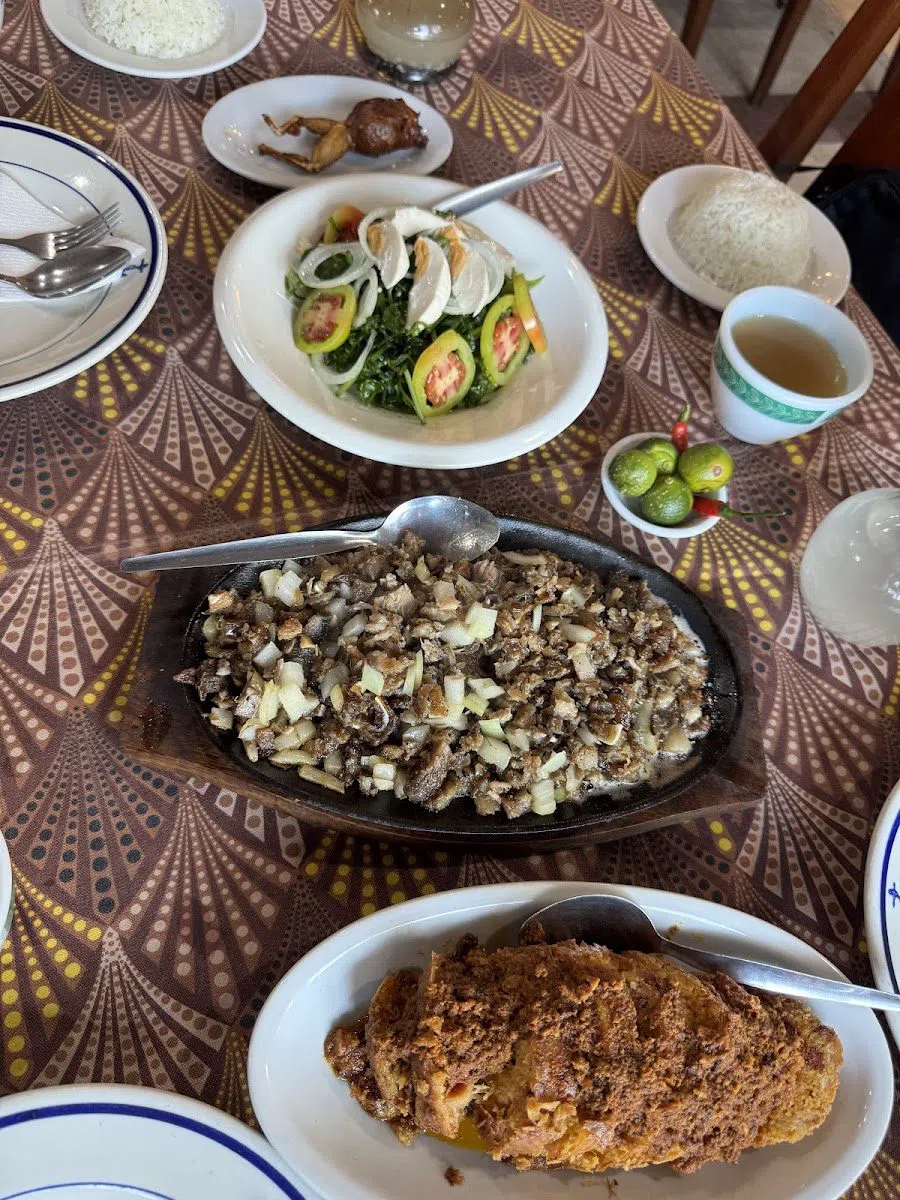
For lunch on the northern leg, Everybody's Cafe (Pampanga, a few minutes from the old station where the boxcars loaded) is the regional reason to stop rather than a highway chain. Pampanga is the country's acknowledged kitchen, and this is Kapampangan home cooking served to tour parties and extended families without ceremony: rich, slow-braised meat dishes, rice cooked in coconut milk with turmeric, and, if you want the dishes the province is actually famous for, the crickets and stuffed frogs that outsiders brace themselves for and locals eat without comment. Budget PHP 300 to 600 a head. It opens roughly 10am to 9pm daily; call +63 45 860 1121 to hold tables for a group. Eating here, minutes from the railhead, with the afternoon heat coming off the car park, lands harder than any plaque.
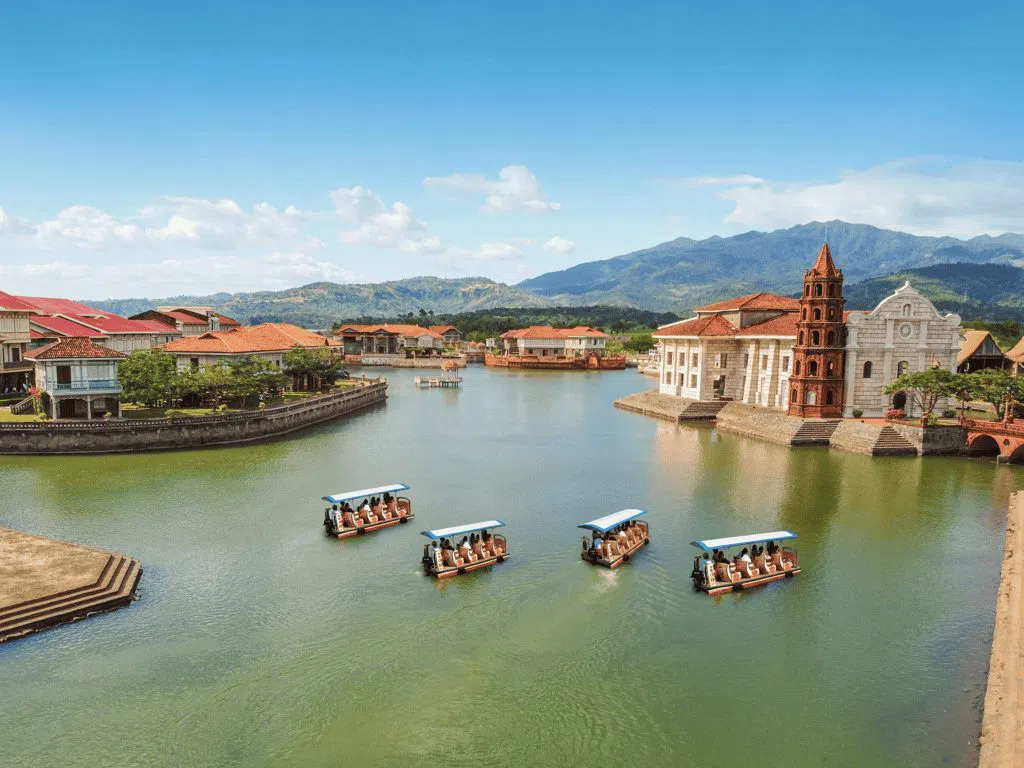
The optional stop is Las Casas Filipinas de Acuzar (Bagac, on the west coast), a heritage park of relocated Spanish-era houses minutes from the Bagac zero-kilometre marker. It has nothing whatsoever to do with the march, and it is where most Bataan car tours take lunch and a swim. Two things to weigh. It is a hard tonal gear-change, from a surrender marker to a costumed heritage walk in under an hour, and at PHP 2,500 on weekdays or PHP 2,900 at weekends, holidays and peak dates for a day tour with guided walk and set lunch, it is by far the biggest line item of the day. If you are travelling with people who need a reward at the end, it works. If the march is the point, skip it and go home earlier.
How long the day takes
This is a ten- to twelve-hour day from the capital, door to door, and it does not compress. Reckon on roughly three hours each way with a clear road, plus the Mariveles plaza and tower, the Lamao marker, the climb to Mount Samat, one coffee, one lunch, and the drive back. Leaving the capital at 5am gets you to kilometre zero before the worst of the heat and back before the evening crush. Leaving at 8am means you arrive at Mount Samat in flat midday light and return in traffic.
Queues are not the constraint here. Nothing on the route has a turnstile except Mount Samat, and its entrance is a booth rather than a line. Heat, distance and daylight are the constraints.
Driving yourself or putting someone else behind the wheel
Zelf rijden kan prima en de toegangskosten zijn bijna niets: ongeveer PHP 50 bij Mount Samat, overal elders gratis, plus brandstof en tolkosten voor de snelweg. Waar je voor betaalt bij een gehuurde auto en gids, is het aan elkaar rijgen: weten welke onmarkeerde berm de overgavelocatie is, welke afslag naar het heiligdom omhoog klimt, en hoe je de dag zo indeelt dat hij opbouwt in plaats van doelloos wordt. Er bestaat een begeleide optie die vooraf geboekt kan worden. Begeleide privéreizen van een volle dag vertrekken hier vanaf 375 USD per persoon, rijden zeven dagen per week, en de best beoordeelde krijgt 4,7 uit 5 van 44 reizigersrecensies. Dat is een groot verschil met een kaartje van PHP 50, dus bepaal eerlijk welk probleem je oplost: de historische uitleg en het rijden, of de entreeprijs.
Als je zelf rijdt, huur de auto dan voor de hele dag in plaats van per uur, neem contant geld mee, en vertel de chauffeur de route voordat je vertrekt. Veel chauffeurs uit de hoofdstad kennen Mount Samat en Las Casas, maar hebben nog nooit van de markering in Lamao gehoord.
Toegang, regels en goed gedrag
Alle markeringen staan op openbare grond en geen enkele beperkt fotografie. Er is geen kledingvoorschrift, maar Mount Samat is een heiligdom en een monument naast een begraafplaats, en Filipijnse families behandelen het als zodanig. Bedek je schouders, praat zachtjes op de esplanade en klim niet op de reliëfs van de Colonnade. Bloemen leggen bij Mariveles en bij de Friendship Tower is normaal en vereist geen ticket; als je bloemen wilt neerleggen, koop ze dan voordat je de provinciehoofdstad verlaat.
Toegankelijkheid is gemengd en dat is de moeite waard om duidelijk te zeggen. Het plein in Mariveles, het park van de Friendship Tower en de esplanade van Mount Samat zijn vlak, verhard en met een rolstoel goed te doen. De markering in Lamao is een berm langs de weg. Omdat de lift in het kruis buiten dienst is voor de renovatie, is er momenteel geen drempelvrije route naar een verhoogd uitzichtpunt bij het heiligdom.
Is het de moeite waard
Ja, met één voorwaarde: het is de moeite waard als je de geschiedenis wilt en bereid bent een lange dag in de auto te accepteren om die te krijgen. Er is aan het eind geen spektakel, het enige museum op de route is dicht, en de meest aangrijpende stop is een onmarkeerde berm in Limay. Wat je ervoor terugkrijgt, is het landschap: de zee bij kilometer nul, de bergweg die uit Mariveles omhoog klimt, de vlakte van Pampanga waar het spoorwegstation lag, en de afstand ertussen, die je voelt door je eigen voorruit.
Het past bij geschiedenislezers, iedereen met een familieband met de oorlog in de Stille Oceaan, en Japanse en Amerikaanse reizigers die naast de gruwel ook de verzoening willen zien. Het past beter bij kleine groepen in een auto dan bij touringcars, omdat twee van de beste stops geen grote groep kunnen opvangen. Het past niet bij kleine kinderen en niet bij wie een ontspannen dag aan het strand met buffet zoekt. Voor dat laatste kun je een reis rond alleen het erfgoedpark bouwen en de mars helemaal buiten beschouwing laten.
Beste tijd om te gaan
Ga in het droge seizoen, ruwweg van december tot en met april, en ga op een doordeweekse dag. De mars zelf vond plaats in april, en de droge hitte hoort bij wat je wilt begrijpen, maar om 11 uur 's ochtends is het op de open esplanade van Mount Samat meedogenloos. Begin dus bij zonsopgang en doe het meeste lopen vroeg. De herdenking op 9 april brengt veteranenfamilies, functionarissen en mensenmassa's naar Mount Samat. Het is aangrijpend als je dat wilt, maar de verkeerde dag helemaal als je de kam voor jezelf wilt hebben.
Het regenseizoen, ruwweg van juni tot en met oktober, is niet af te schrijven. De markeringen staan in de open lucht en zijn gratis, de heuvels worden groen, en je hebt de plek bijna alleen. Maar de bergweg is glad, het uitzicht vanaf de kam kan in de wolken verdwijnen, en een tyfoondag annuleert je plannen gewoon. Begeleide reizen van een volle dag rijden hier zeven dagen per week, dus de dag van de week kies je zelf; kies dinsdag tot donderdag als je kunt, wanneer de parkeerplaats van het heiligdom niet vol staat met schoolbussen.
De middagzon op de Colonnade maakt de betere foto; de ochtendlucht geeft het betere uitzicht. Je kunt tijdens één bezoek niet beide hebben.
Praktische tips
Je komt er alleen per weg, en het snelwegennet ten westen en noorden van de hoofdstad doet het meeste werk voordat je de nationale weg op het schiereiland neemt. Drie uur per richting is een goede planningsschatting; reken een uur extra voor de klim naar het heiligdom en terug naar beneden. Met de bus kom je technisch gezien tot de provinciehoofdstad, maar je kunt Mariveles, Lamao en Mount Samat niet in één dag met jeepneys verbinden, dus een auto is in de praktijk verplicht.
Neem pesos in kleine biljetten mee. Het loket bij Mount Samat, de stalletjes langs de weg en de tricycle-chauffeurs werken met contant geld. Koffie en lunch nemen meestal een pinpas, maar reken er niet op, en bij de markeringen zijn er nergens in de buurt geldautomaten.
Voor de timing: om 5 uur 's ochtends uit de hoofdstad, om 8 uur bij kilometer nul, halverwege de ochtend in Lamao, vóór het middaguur bij Mount Samat, lunch op het noordelijke traject, en 's avonds vroeg thuis.
Als je zelf rijdt, komt het budget neer op ongeveer PHP 50 entree bij Mount Samat, niets bij de andere drie monumenten, PHP 150 tot 350 voor koffie, PHP 300 tot 600 per persoon voor een Kapampangan-lunch, plus brandstof en tol. Reken PHP 2,500 tot PHP 2,900 per persoon extra als je het erfgoedpark meeneemt. Begeleide privéreizen van een volle dag beginnen bij 375 USD per persoon.
Doe dit als dagtocht en houd je basis in de hoofdstad. Er is geen voordeel in overnachten op het schiereiland, tenzij je in het erfgoedpark zelf verblijft. Vergelijk de prijzen via Manila hotelzoeker, en als je rond dit een langer verblijf plant, staat de rest van de stad in onze Manila-gids.
Neem meer water mee dan je denkt, en een hoed. De mannen over wie je leest, hadden geen van beide.
Voor vertrek
Hoe lang duurt de Bataan Death March-dagtocht vanuit Manila?
Tien tot twaalf uur van deur tot deur. Ongeveer drie uur rijden heen en terug, plus het plein in Mariveles en de Friendship Tower, de overgavemarkering in Lamao, een uur of zo bij Mount Samat, en een lunchstop. Vertrek om 5 uur 's ochtends om kilometer nul te bereiken vóór de hitte en kom thuis vóór het avondverkeer.
Kun je nog steeds binnenin het kruis op Mount Samat naar boven?
Nee. De lift in het kruis, het uitkijkplatform in zijn armen en het heiligdomsmuseum zijn allemaal dicht voor structurele renovatie, PVAO-werkzaamheden die sinds 2025 lopen, met een nieuw bezoekerscomplex van PHP 170 miljoen dat rond juni 2027 klaar moet zijn. De Colonnade, het altaar en de uitzichten vanaf de kam zijn nog open, en de entree kost ongeveer PHP 50 per persoon met gratis parkeren.
Heb ik een gids nodig, of kan ik de route zelf rijden?
Je kunt zelf rijden; de markeringen zijn openbaar en vereisen geen ticket, en het enige toegangsgeld op de route is voor Mount Samat. Met een gids krijg je de juiste volgorde en de uitleg, vooral bij de overgavemarkering in Lamao, een niet-aangegeven berm langs de weg die de meeste chauffeurs uit de hoofdstad nooit gehoord hebben. Begeleide privéreizen van een volle dag rijden zeven dagen per week en vertrekken vanaf 375 USD per persoon.
Wat kost de dag je eigenlijk als je hem zelf organiseert?
Ongeveer PHP 50 entree bij Mount Samat en niets bij de andere drie monumenten, PHP 150 tot 350 voor koffie, PHP 300 tot 600 per persoon voor een Kapampangan-lunch, plus brandstof en tolkosten voor de snelweg. Het erfgoedpark in Bagac is de grootste afzonderlijke kostenpost met PHP 2,500 op weekdagen of PHP 2,900 in het weekend, op feestdagen en tijdens drukke data.
Is het te doen met het openbaar vervoer?
Niet echt. Bussen brengen je naar de provinciehoofdstad van Bataan, maar Mariveles, de markering in Lamao en het heuvelheiligdom in één dag verbinden met jeepneys en tricycles lukt niet. De afstanden zijn te groot en de weg naar het heiligdom is een steile klim zonder openbaar vervoer. Reken een auto, gehuurd of eigen, als verplicht.